Transform your photos into Hawkins! Learn to use Nanobanana and Gemini prompts to master cinematic lighting, 80s textures, and Upside Down aesthetics.
Mastering the “Stranger Things” Cinematic Aesthetic with AI
Have you ever finished an episode of Stranger Things and wished you could step through the screen? The show isn’t just a series; it’s a mood. That heavy, 80s-tinted atmosphere is iconic. Now, thanks to tools like Nanobanana and Gemini prompts, you don’t have to be a Hollywood director to create your own piece of Hawkins. You can place yourself right in the middle of the action.
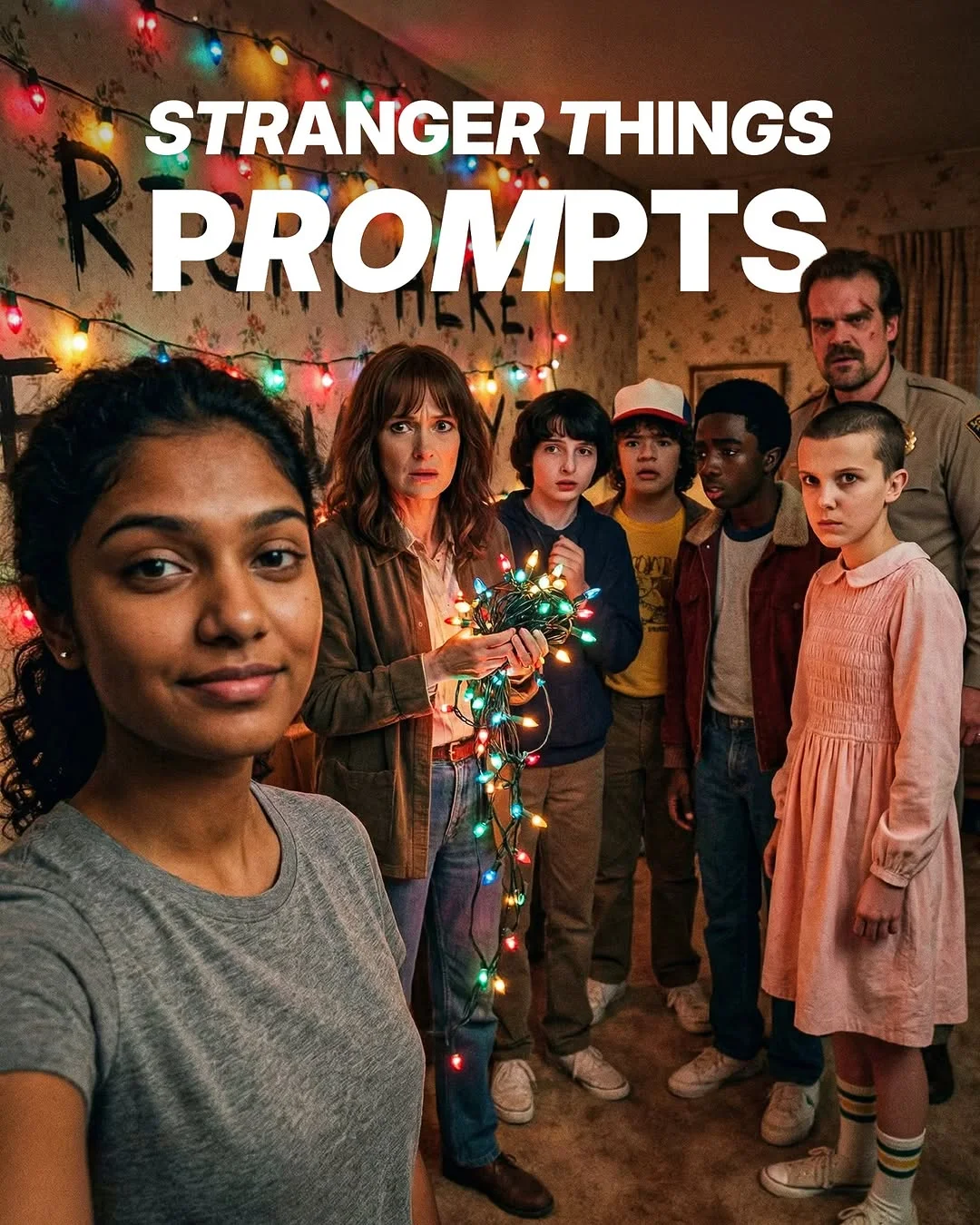 STRANGER THINGS PROMPTS
What is the Stranger Things Aesthetic?
The Stranger Things aesthetic is a masterclass in nostalgia-driven sci-fi horror. It’s a mix of “Amblin-style” adventure and gritty, dark fantasy. Visually, it’s defined by a specific look: a blend of 1980s suburban warmth and the cold, decaying rot of the Upside Down.
When we talk about this style in cinematic AI image generation, we’re looking for high-contrast lighting, a film-grain texture, and a sense of “tension.” It’s not just about drawing a monster; it’s about making the viewer feel like something is lurking just outside the frame.
Benefits of Using Nanobanana for Cinematic Art
For many AI hobbyists, getting a specific “look” can be frustrating. You might get a great character, but the lighting feels flat. This is where Nanobanana prompts come in.
Using Nanobanana specialized tools allows you to:
- Maintain Consistency: It helps keep faces and styles identical across different scenes.
- Simplify Complex Tech: You don’t need to be a coding genius to get 8k resolution results.
- Bridge the Gap: It connects your creative vision with the power of models like Midjourney or Gemini.
Whether you are a beginner or an intermediate user, these tools act like a digital DP (Director of Photography), ensuring your AI fan art tutorial results look like high-budget movie stills.
Key Elements of the Upside Down Atmosphere
To successfully replicate this universe, you need to understand the gears that turn behind the curtain. Here are the four pillars of the “Hawkins Look”:
1. Low-key Lighting and High-Contrast Shadows
The show uses “Rembrandt lighting” and deep shadows to hide things. In your atmospheric lighting prompts, always mention “volumetric shadows” or “harsh silhouettes.”
2. The Iconic Blue and Red Color Palette
The “Right Side Up” uses warm, amber tones. The “Upside Down” uses cold blues, teals, and harsh emergency reds. Mixing these creates that classic retro 80s synthwave prompts feel.
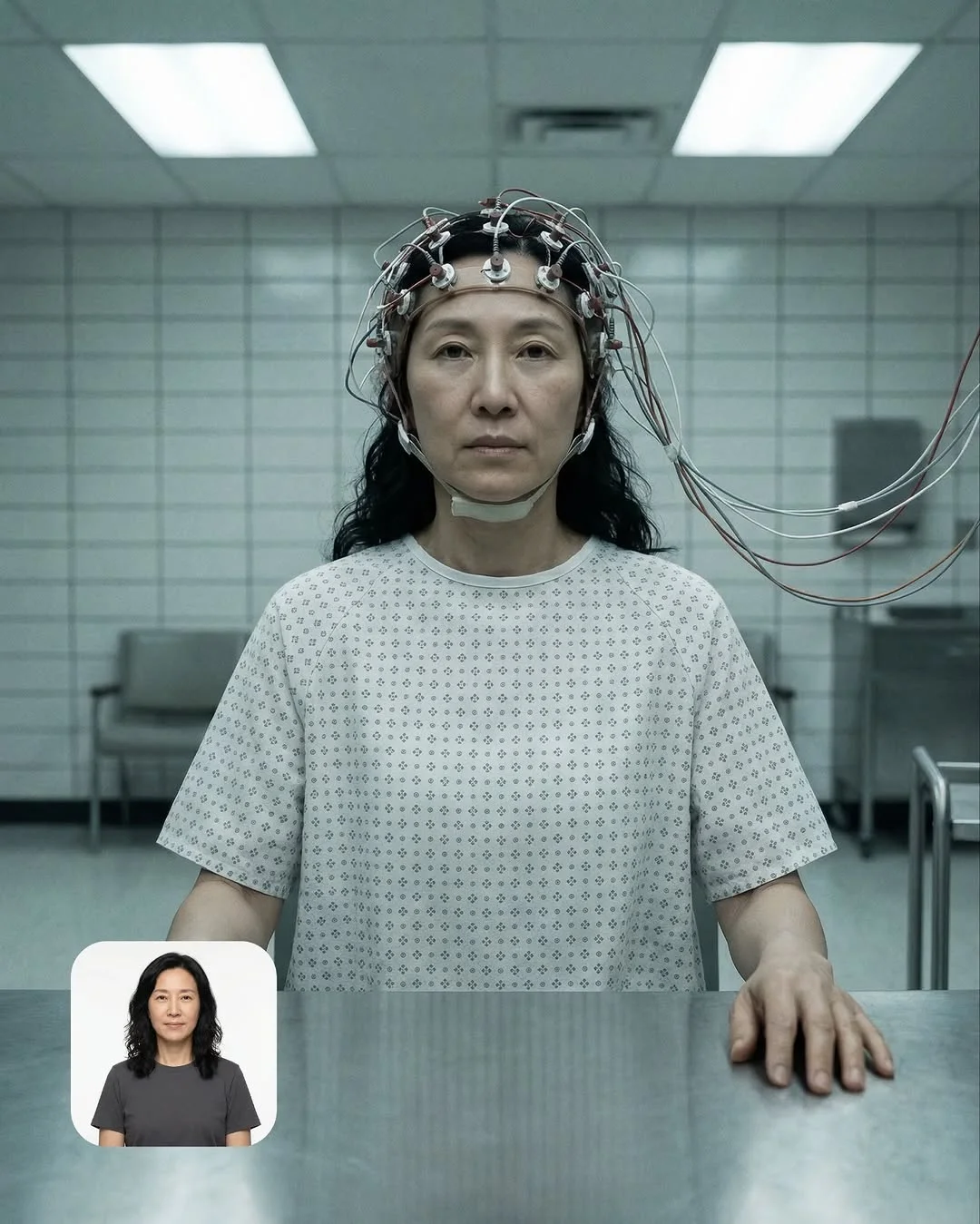 Cinematic shot. An Asian woman in her 50s seated at a metal table in a clinical, white-tiled observation room. She is wearing a patterned hospital gown and has an elaborate EEG-like headset with numerous wires connected to her scalp and extending off-camera. The lighting is cold and fluorescent, with subtle shadows that enhance the sterile, slightly eerie atmosphere. Wide shot. The woman’s expression is neutral and distant. The background shows blurred medical equipment and a stark, institutional setting. Photorealistic, 8k resolution, highly detailed, dramatic composition. —ar 4:5 —v 6.1
3. Floating Particles and Volumetric Fog
You can’t have a dark fantasy AI prompts session without “spores.” Mention “floating ash,” “drifting particles,” or “thick low-lying fog” to add layers of depth to your scene.
4. 80s Synthwave Textures and Grain
Digital art often looks too “clean.” To make it cinematic, you need grit. Adding “35mm film grain” or “slight motion blur” makes the image feel like a captured moment from a VHS tape.
How to Craft Prompts for the Stranger Things Universe
Writing a prompt is like giving directions to a driver. If you’re vague, you’ll get lost. Here’s how to structure your creative AI prompts for Instagram:
Defining the Cinematic Camera Angle
Instead of just saying “a girl in the woods,” specify the gear. Use terms like “50mm lens,” “low-angle hero shot,” or “candid selfie style.” This tells the AI how to frame the character.
Describing the Eerie Environmental Tension
Keywords like “oppressive atmosphere,” “clinical sterile room,” or “approaching storm” help the AI understand the feeling of the shot, not just the objects in it.
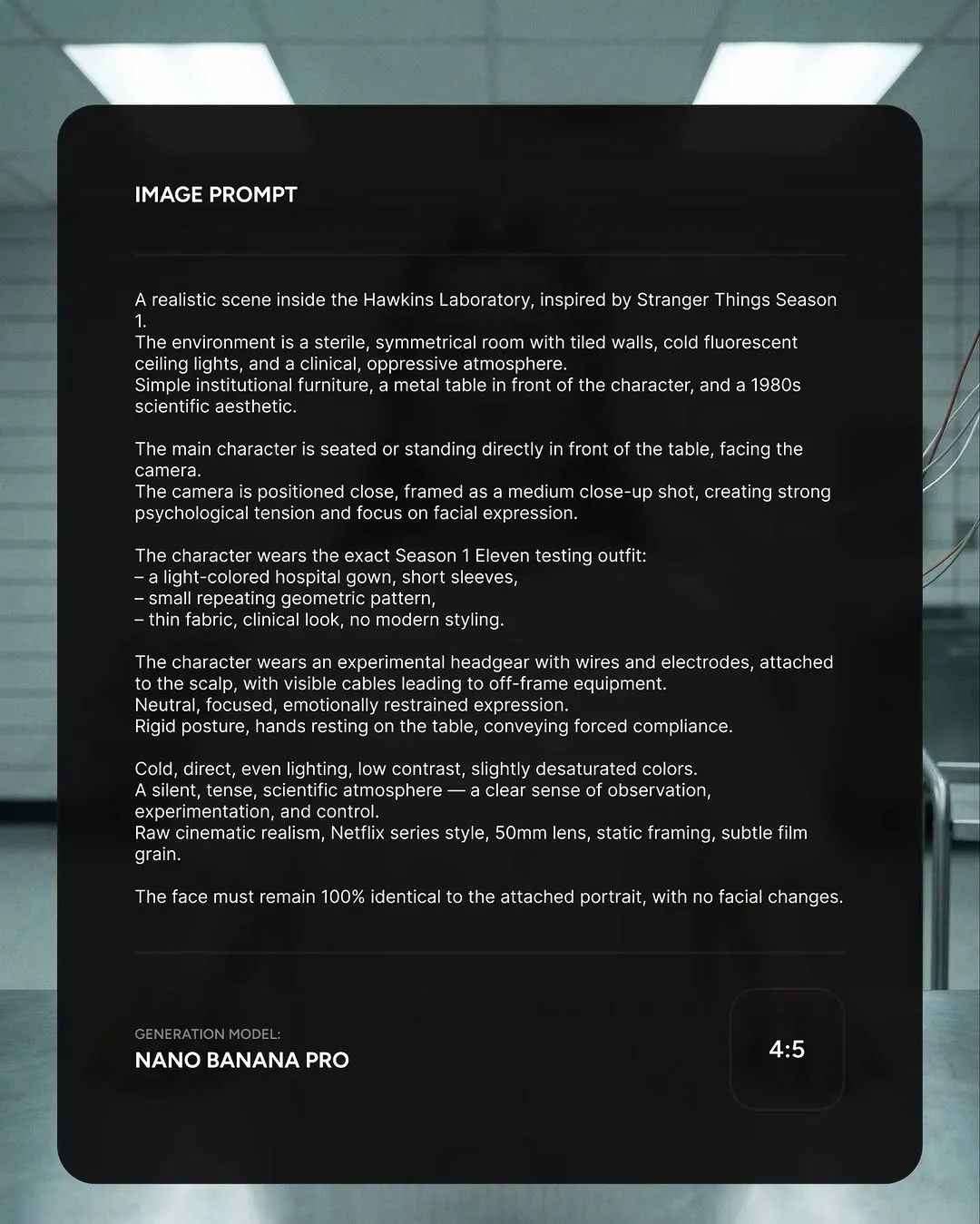 A realistic scene inside the Hawkins Laboratory, inspired by Stranger Things Season 1. The environment is a sterile, symmetrical room with tiled walls, cold fluorescent ceiling lights, and a clinical, oppressive atmosphere. Simple institutional furniture, a metal table in front of the character, and a 1980s scientific aesthetic. The main character is seated or standing directly in front of the table, facing the camera. The camera is positioned close, framed as a medium close-up shot, creating strong psychological tension and focus on facial expression. The character wears the exact Season 1 Eleven testing outfit: – a light-colored hospital gown, short sleeves, – small repeating geometric pattern, – thin fabric, clinical look, no modern styling. The character wears an experimental headgear with wires and electrodes, attached to the scalp, with visible cables leading to off-frame equipment. Neutral, focused, emotionally restrained expression. Rigid posture, hands resting on the table, conveying forced compliance. Cold, direct, even lighting, low contrast, slightly desaturated colors. A silent, tense, scientific atmosphere — a clear sense of observation, experimentation, and control. Raw cinematic realism, Netflix series style, 50mm lens, static framing, subtle film grain. The face must remain 100% identical to the attached portrait, with no facial changes.
Incorporating Specific Character Details
To get AI character design right, describe the textures. Mention the “thin fabric of a hospital gown” or the “matted fur of a Demogorgon.” If you want to include yourself, specify “keep my exact facial structure.”
Using “Nanobanana” Keywords for Style
Keywords like #nanobananapro or specific Gemini image prompts structures ensure the AI doesn’t default to a generic cartoon style. It locks the engine into a “cinematic realism” mode.
Why Use Gemini Prompts for AI Narrative Art
Gemini image prompts are incredible for immersive storytelling AI. Because Gemini understands context so well, you can describe a whole story arc in your prompt. Instead of just “man in forest,” you can describe “a man realizing he is being hunted in the Hawkins woods, 1983.” The AI uses that narrative context to adjust the character’s facial expression and the environmental lighting.
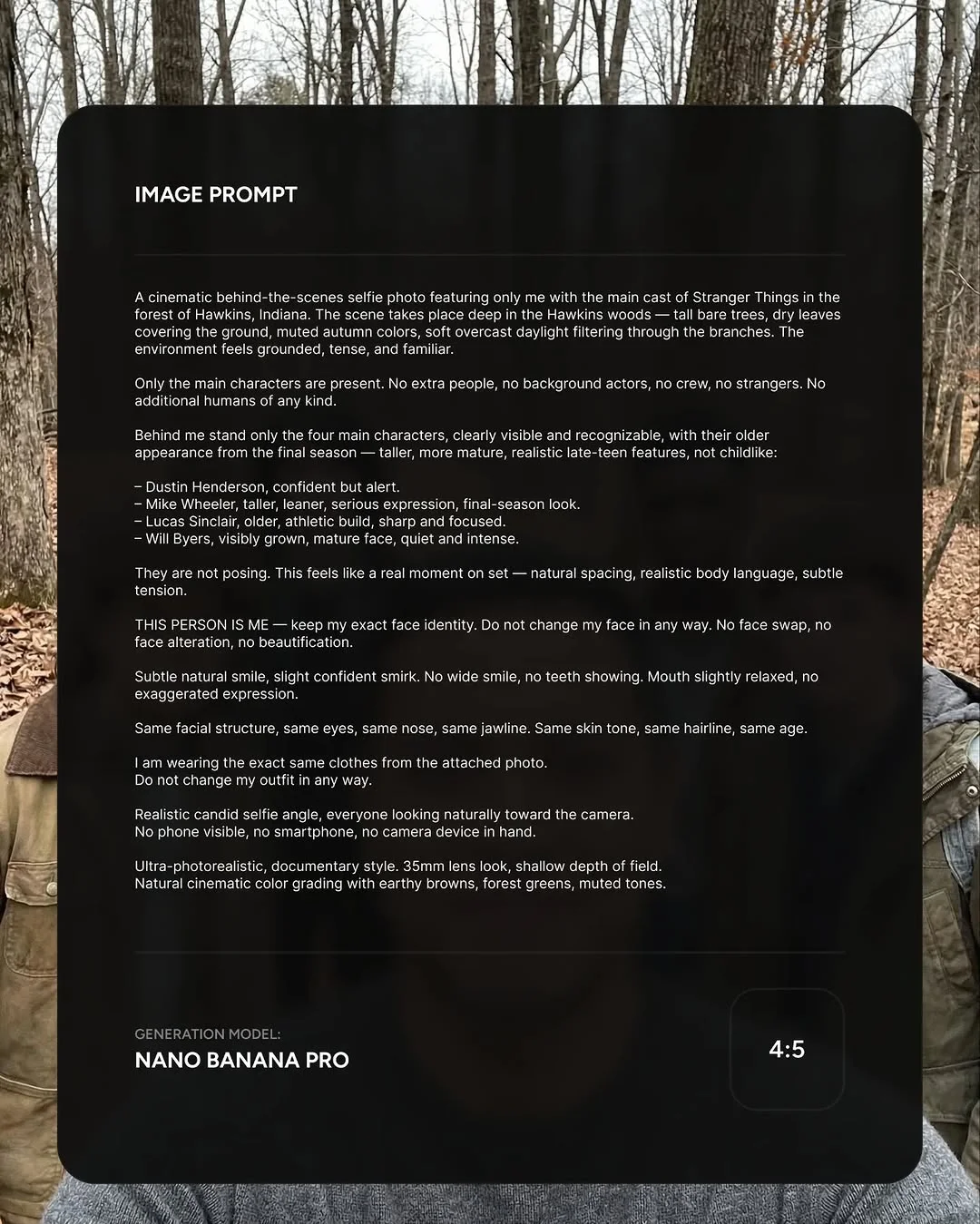 A cinematic behind-the-scenes selfie photo featuring only me with the main cast of Stranger Things in the forest of Hawkins, Indiana. The scene takes place deep in the Hawkins woods — tall bare trees, dry leaves covering the ground, muted autumn colors, soft overcast daylight filtering through the branches. The environment feels grounded, tense, and familiar. Only the main characters are present. No extra people, no background actors, no crew, no strangers. No additional humans of any kind. Behind me stand only the four main characters, clearly visible and recognizable, with their older appearance from the final season — taller, more mature, realistic late-teen features, not childlike: – Dustin Henderson, confident but alert. – Mike Wheeler, taller, leaner, serious expression, final-season look. – Lucas Sinclair, older, athletic build, sharp and focused. – Will Byers, visibly grown, mature face, quiet and intense. They are not posing. This feels like a real moment on set — natural spacing, realistic body language, subtle tension. THIS PERSON IS ME — keep my exact face identity. Do not change my face in any way. No face swap, no face alteration, no beautification. Subtle natural smile, slight confident smirk. No wide smile, no teeth showing. Mouth slightly relaxed, no exaggerated expression. Same facial structure, same eyes, same nose, same jawline. Same skin tone, same hairline, same age. I am wearing the exact same clothes from the attached photo. Do not change my outfit in any way. Realistic candid selfie angle, everyone looking naturally toward the camera. No phone visible, no smartphone, no camera device in hand. Ultra-photorealistic, documentary style. 35mm lens look, shallow depth of field. Natural cinematic color grading with earthy browns, forest greens, muted tones.
If you’ve seen the post by adventuregen.ai, you know there’s a shortcut. You don’t have to spend hours guessing the right words.
- Connecting with the Community: Head over to the Instagram post and join the conversation.
- Activating the DM Automation: Simply comment “ST” on the post. This triggers a specialized tool that sends the exact prompt recipe to your DMs.
- Integrating with Your Workflow: Once you have the tool, you can paste the prompts into your favorite generator (like Gemini or Midjourney) and watch the magic happen.
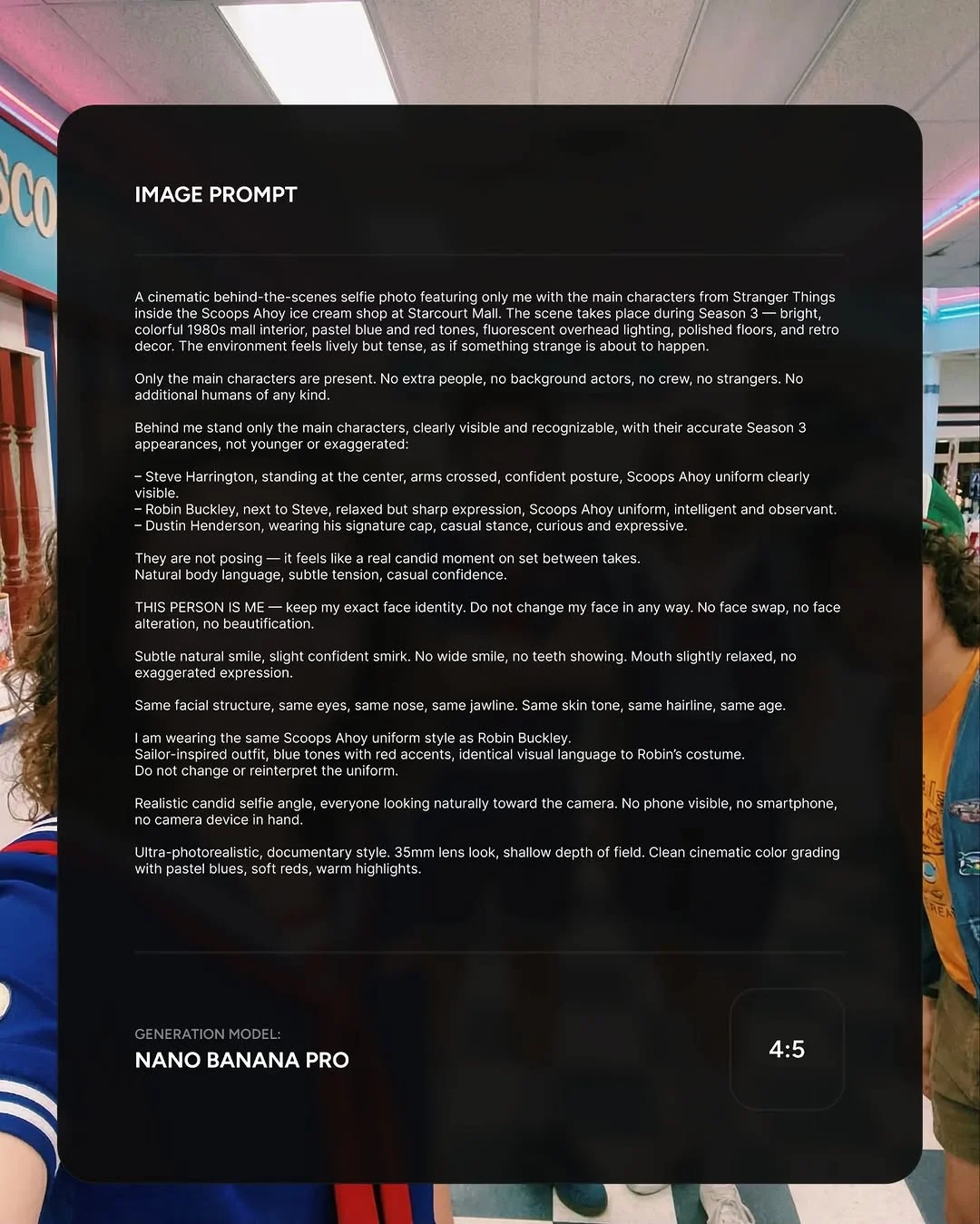 A cinematic behind-the-scenes selfie photo featuring only me with the main characters from Stranger Things inside the Scoops Ahoy ice cream shop at Starcourt Mall. The scene takes place during Season 3 — bright, colorful 1980s mall interior, pastel blue and red tones, fluorescent overhead lighting, polished floors, and retro decor. The environment feels lively but tense, as if something strange is about to happen. Only the main characters are present. No extra people, no background actors, no crew, no strangers. No additional humans of any kind. Behind me stand only the main characters, clearly visible and recognizable, with their accurate Season 3 appearances, not younger or exaggerated: – Steve Harrington, standing at the center, arms crossed, confident posture, Scoops Ahoy uniform clearly visible. – Robin Buckley, next to Steve, relaxed but sharp expression, Scoops Ahoy uniform, intelligent and observant. – Dustin Henderson, wearing his signature cap, casual stance, curious and expressive. They are not posing — it feels like a real candid moment on set between takes. Natural body language, subtle tension, casual confidence. THIS PERSON IS ME — keep my exact face identity. Do not change my face in any way. No face swap, no face alteration, no beautification. Subtle natural smile, slight confident smirk. No wide smile, no teeth showing. Mouth slightly relaxed, no exaggerated expression. Same facial structure, same eyes, same nose, same jawline. Same skin tone, same hairline, same age. I am wearing the same Scoops Ahoy uniform style as Robin Buckley. Sailor-inspired outfit, blue tones with red accents, identical visual language to Robin’s costume. Do not change or reinterpret the uniform. Realistic candid selfie angle, everyone looking naturally toward the camera. No phone visible, no smartphone, no camera device in hand. Ultra-photorealistic, documentary style. 35mm lens look, shallow depth of field. Clean cinematic color grading with pastel blues, soft reds, warm highlights.
Tips for Enhancing Your AI-Generated Scenes
Even with high-quality AI art tools, the first result might not be perfect. Here is how to take it from good to professional:
Post-Processing for a Vintage Look
Once you generate your image, use a photo editor to add a “halation” effect (a red glow around bright lights). This mimics old film stock and enhances the Stranger Things aesthetic lighting.
Iterating on Prompts for Better Lighting
If your scene is too dark, don’t just add “bright.” Instead, add “rim lighting” or “neon glow from a shop window.” This keeps the cinematic atmosphere AI vibe without washing out the shadows.
Mixing Fan-Art Concepts
Don’t just stick to the show’s script. Use sci-fi horror prompts to put original characters in iconic locations like Castle Byers.
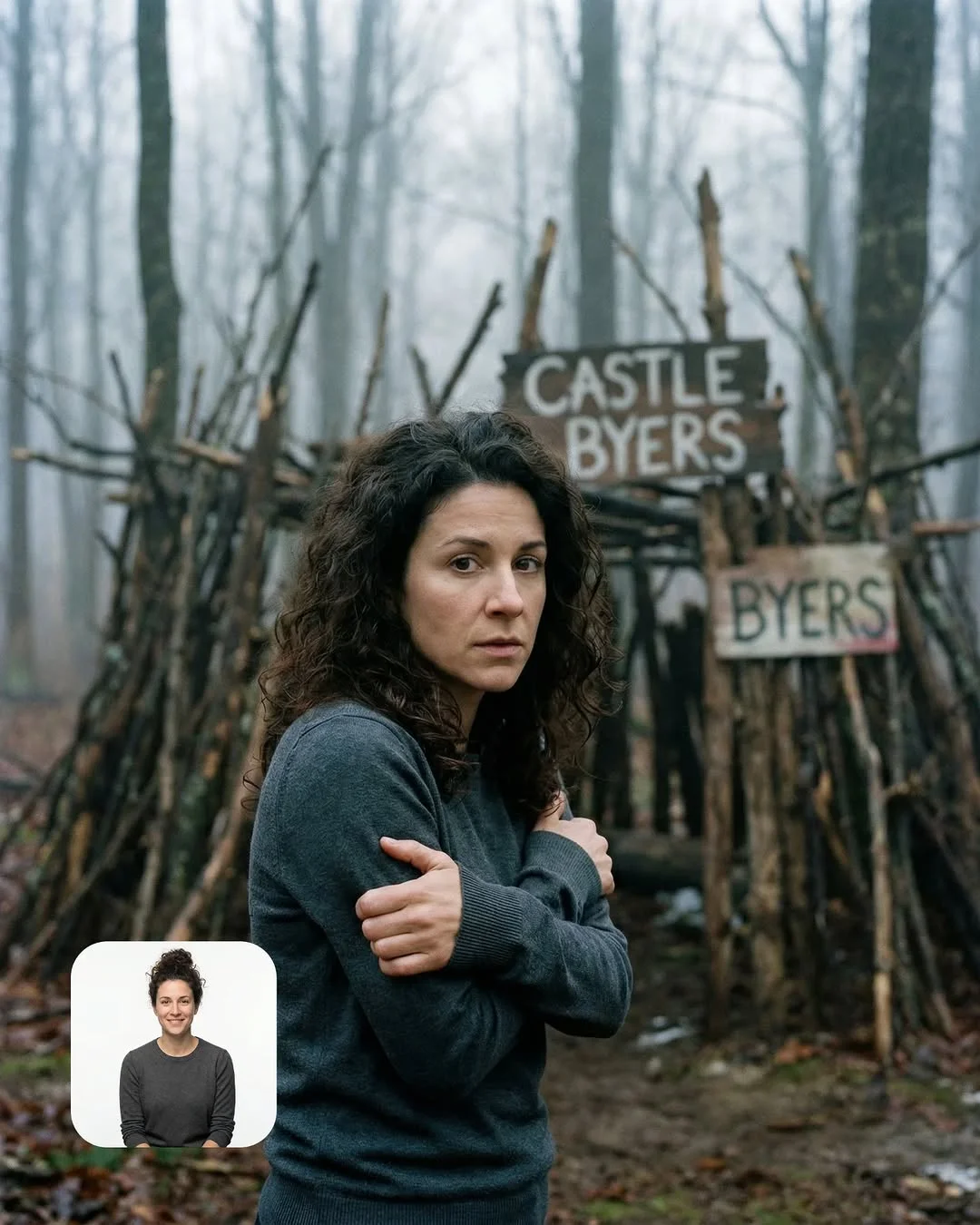 a female standing in the woods near a wooden structure. The structures has a sign with the words Castle Byers. The shot is a full body shot. Foggy movie atmospheric. Look Into the camera. Sharp focus. 35mm lens. high quality. Detailed background. Cinematic lighting. —ar 4:5 —stylize 250 —v 6.0
The Future of Fan-Driven Cinematic Storytelling
We are entering an era where fans are no longer just viewers; they are creators. Using generative AI for beginners, anyone can now visualize their own “fan-fiction” episodes with photorealistic quality. The barrier between “fan art” and “professional concept art” is disappearing. By mastering these film-inspired AI imagery techniques, you aren’t just making a picture—you’re building a world.
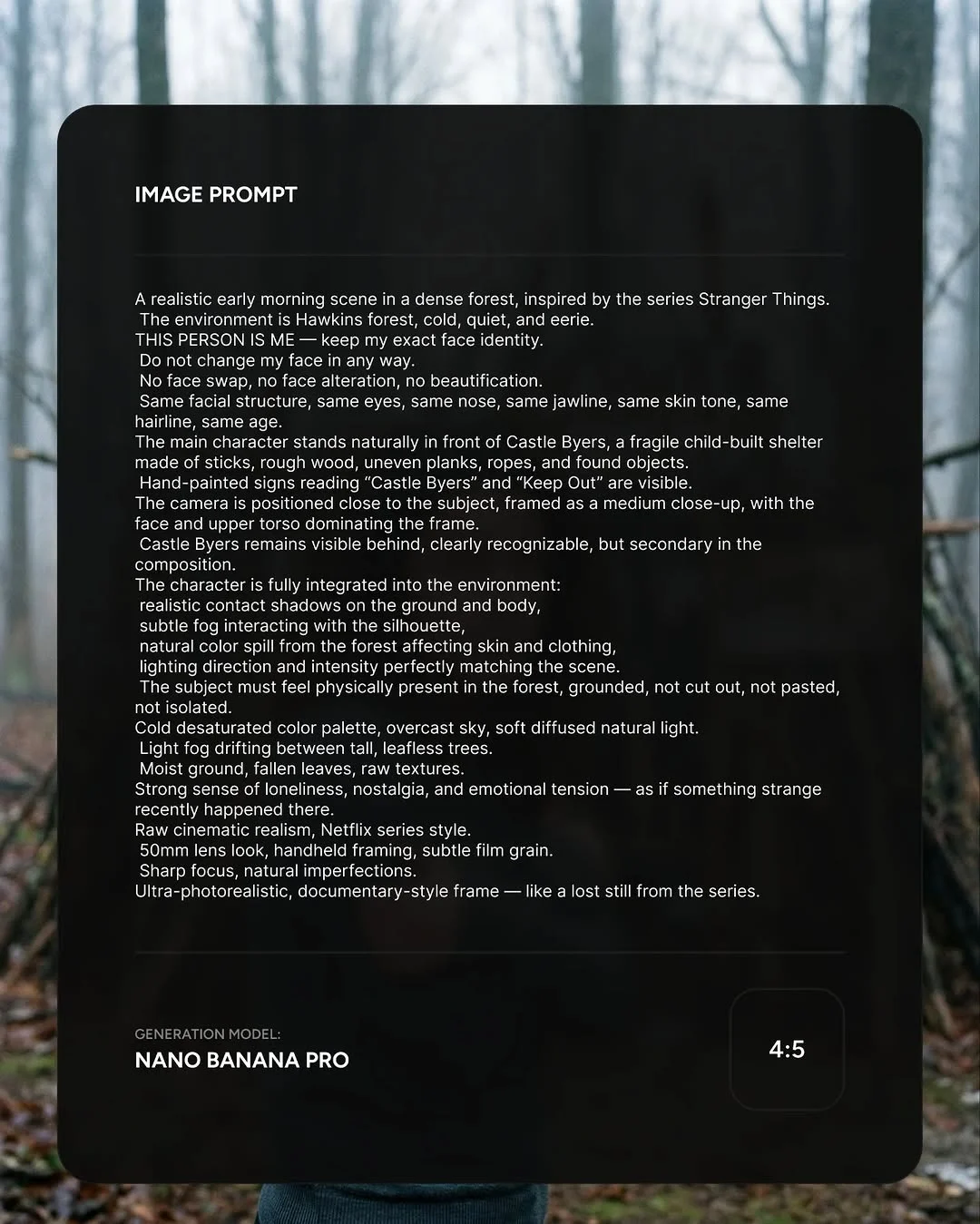 A realistic early morning scene in a dense forest, inspired by the series Stranger Things. The environment is Hawkins forest, cold, quiet, and eerie. THIS PERSON IS ME — keep my exact face identity. Do not change my face in any way. No face swap, no face alteration, no beautification. Same facial structure, same eyes, same nose, same jawline, same skin tone, same hairline, same age. The main character stands naturally in front of Castle Byers, a fragile child-built shelter made of sticks, rough wood, uneven planks, ropes, and found objects. Hand-painted signs reading “Castle Byers” and “Keep Out” are visible. The camera is positioned close to the subject, framed as a medium close-up, with the face and upper torso dominating the frame. Castle Byers remains visible behind, clearly recognizable, but secondary in the composition. The character is fully integrated into the environment: realistic contact shadows on the ground and body, subtle fog interacting with the silhouette, natural color spill from the forest affecting skin and clothing, lighting direction and intensity perfectly matching the scene. The subject must feel physically present in the forest, grounded, not cut out, not pasted, not isolated. Cold desaturated color palette, overcast sky, soft diffused natural light. Light fog drifting between tall, leafless trees. Moist ground, fallen leaves, raw textures. Strong sense of loneliness, nostalgia, and emotional tension — as if something strange recently happened there. Raw cinematic realism, Netflix series style. 50mm lens look, handheld framing, subtle film grain. Sharp focus, natural imperfections. Ultra-photorealistic, documentary-style frame — like a lost still from the series.
Frequently Asked Questions
1. What is the “ST” tool mentioned in the post?
It is a tailored set of Nanobanana prompts and automation settings designed specifically to replicate the Stranger Things universe style. It helps you get the lighting, costumes, and atmosphere right every time.
2. Do I need a paid subscription to use these AI prompts?
While many high-end generators like Midjourney require a subscription, you can often use Gemini image prompts through Google’s free or tiered versions to get amazing results.
3. Can I use these prompts for characters other than the Stranger Things cast?
Absolutely! The prompts are designed as “frameworks.” You can swap “Eleven” for your own name or a unique character, and the AI will still apply the same cinematic AI art filters and lighting.
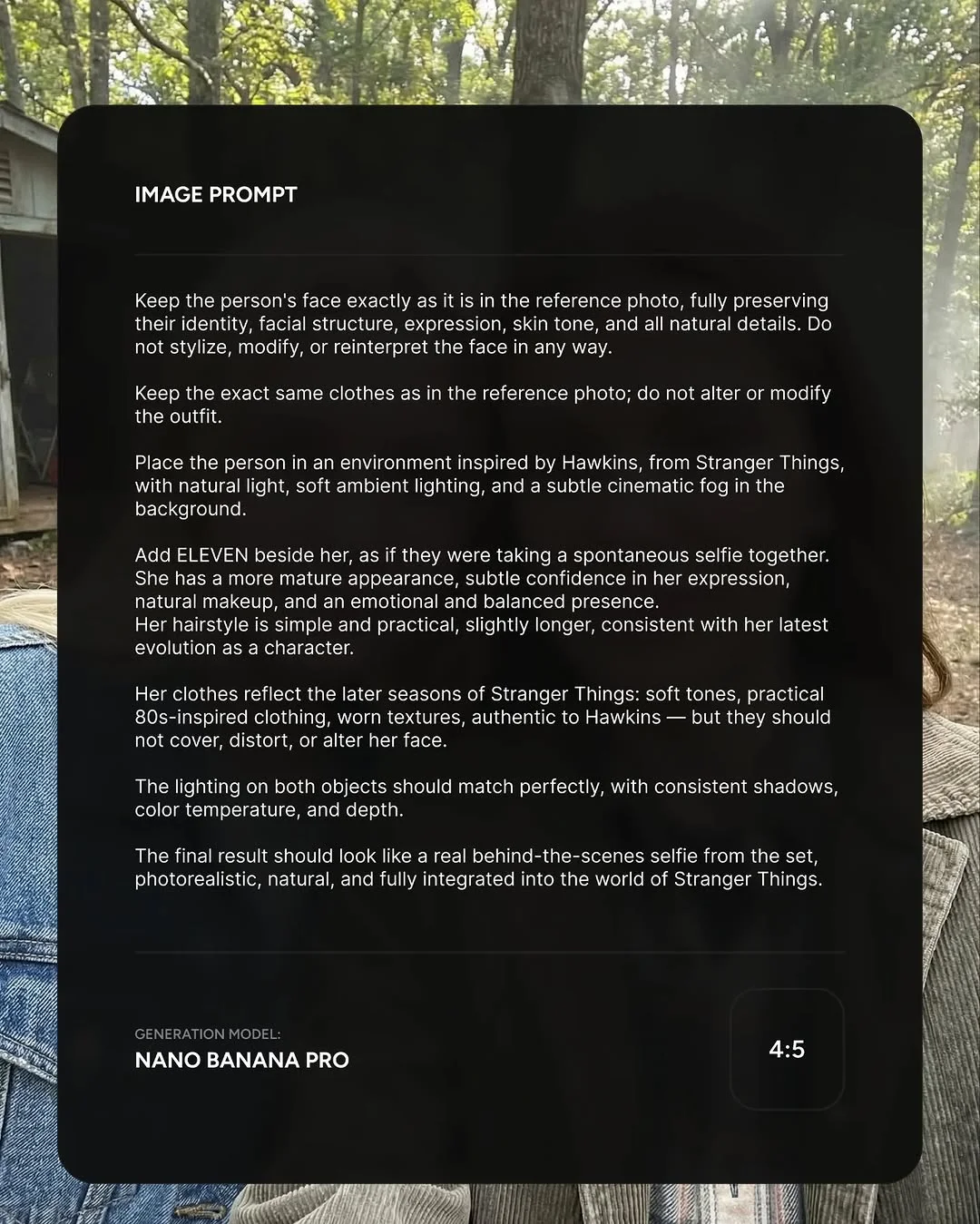 Keep the person’s face exactly as it is in the reference photo, fully preserving their identity, facial structure, expression, skin tone, and all natural details. Do not stylize, modify, or reinterpret the face in any way. Keep the exact same clothes as in the reference photo; do not alter or modify the outfit. Place the person in an environment inspired by Hawkins, from Stranger Things, with natural light, soft ambient lighting, and a subtle cinematic fog in the background. Add ELEVEN beside her, as if they were taking a spontaneous selfie together. She has a more mature appearance, subtle confidence in her expression, natural makeup, and an emotional and balanced presence. Her hairstyle is simple and practical, slightly longer, consistent with her latest evolution as a character. Her clothes reflect the later seasons of Stranger Things: soft tones, practical 80s-inspired clothing, worn textures, authentic to Hawkins — but they should not cover, distort, or alter her face. The lighting on both objects should match perfectly, with consistent shadows, color temperature, and depth. The final result should look like a real behind-the-scenes selfie from the set, photorealistic, natural, and fully integrated into the world of Stranger Things.
4. Is Nanobanana compatible with Midjourney or DALL-E?
Yes, Nanobanana prompts are designed to be versatile. However, they shine brightest when used with models that support high-detail realism and specific aspect ratios.
5. How do I get the “tension” effect in my AI images?
Tension comes from the invisible. Use keywords like “anticipating,” “looking off-camera,” “scared expressions,” and “shadowy figure in the distant background.”
 Ultra realistic and cinematic, documentary-style photo set in Hawkins. The main characters stand very close to the camera in the foreground, occupying most of the frame. They are Max Mayfield and Lucas Sinclair reacting instinctively scared expressions, tense body language, not posing. The camera is close and low, creating urgency and intimacy. They appear almost caught mid-step, as if retreating toward the camera. In the deep background, Vecna is approaching, walking forward from the darkness. He is clearly separated from the group by distance, larger in scale but farther away. Vecna is not attacking, only advancing. The setting is nighttime Hawkins, dark streets or forest outskirts, grounded and realistic. Uneven practical lighting, natural shadows, gritty realism, handheld framing. No stylized poses, no fantasy exaggeration. Face identity must remain 100% identical to the provided photos.
6. Are these prompts beginner-friendly?
Yes! The beauty of the “ST” tool is that the hard work (figuring out technical tags) is already done for you. You just need to follow the template.
Keep an eye on adventuregen.ai. They regularly release new presets and digital art presets for various cinematic universes, from sci-fi to high fantasy.