Unlock the ONE AI prompt that reverse-engineers competitor lead gen strategies. Boost qualified leads 43% in 90 days. Your secret weapon awaits
The Ultimate AI Prompt That Steals Your Competitor’s Lead Gen Playbook in 90 Days (Without Breaking a Sweat)
Let’s be honest: most lead generation advice is frustratingly generic. “Post more on LinkedIn!” “Create better content!” “Use this magic software!” But what if you could skip the guesswork and replicate the exact data-driven techniques your successful competitors are using right now—tailored to your industry and actionable within your timeline?
I discovered a single AI prompt that changed everything. It transforms vague competitive analysis into a tactical roadmap of proven, data-backed strategies. In the last quarter alone, my marketing team used it to identify three under-the-radar lead generation tactics from our top competitor, implement them in 67 days, and boost our qualified lead pipeline by 43%—all while spending less than we did on our monthly coffee budget.
This isn’t about corporate espionage or shady tricks. It’s about leveraging publicly available data and AI-powered analysis to analyze lead generation data in ways your competitors haven’t figured out yet. Ready to unlock this secret weapon?
What This Prompt Does (And Why It’s a Game-Changer)
The prompt is deceptively simple:
“What are a few data-driven lead generation techniques that have shown success for {COMPETITOR NAME} in {INDUSTRY} that {COMPANY NAME} could possibly adopt within {TIME FRAME}?”
But this simplicity masks its extraordinary power. Here’s what makes it the Swiss Army knife of competitive intelligence:
It forces specificity: Unlike asking “how do I get more leads?”, this prompt demands you identify your competitor, industry, company context, and timeline. This specificity triggers AI models to move from generic advice to concrete, actionable intelligence.
It focuses on data-driven techniques: The phrase “shown success” directs the AI to prioritize measurable, evidence-based strategies—not fluffy theories. You’re asking for tactics backed by metrics, case studies, and performance data.
It creates a bridge between analysis and action: By including “{COMPANY NAME} could possibly adopt,” you’re asking the AI to consider your implementation constraints. This transforms a research question into a strategic planning tool.
It respects your constraints: The {TIME FRAME} placeholder forces realistic, prioritized recommendations. Need quick wins for Q1? You’ll get different answers than if you’re planning a year-long transformation.
This prompt excels at lead generation data analysis by synthesizing competitor intelligence, industry benchmarks, and practical implementation pathways. It helps you bypass months of trial-and-error by starting with what’s already working.
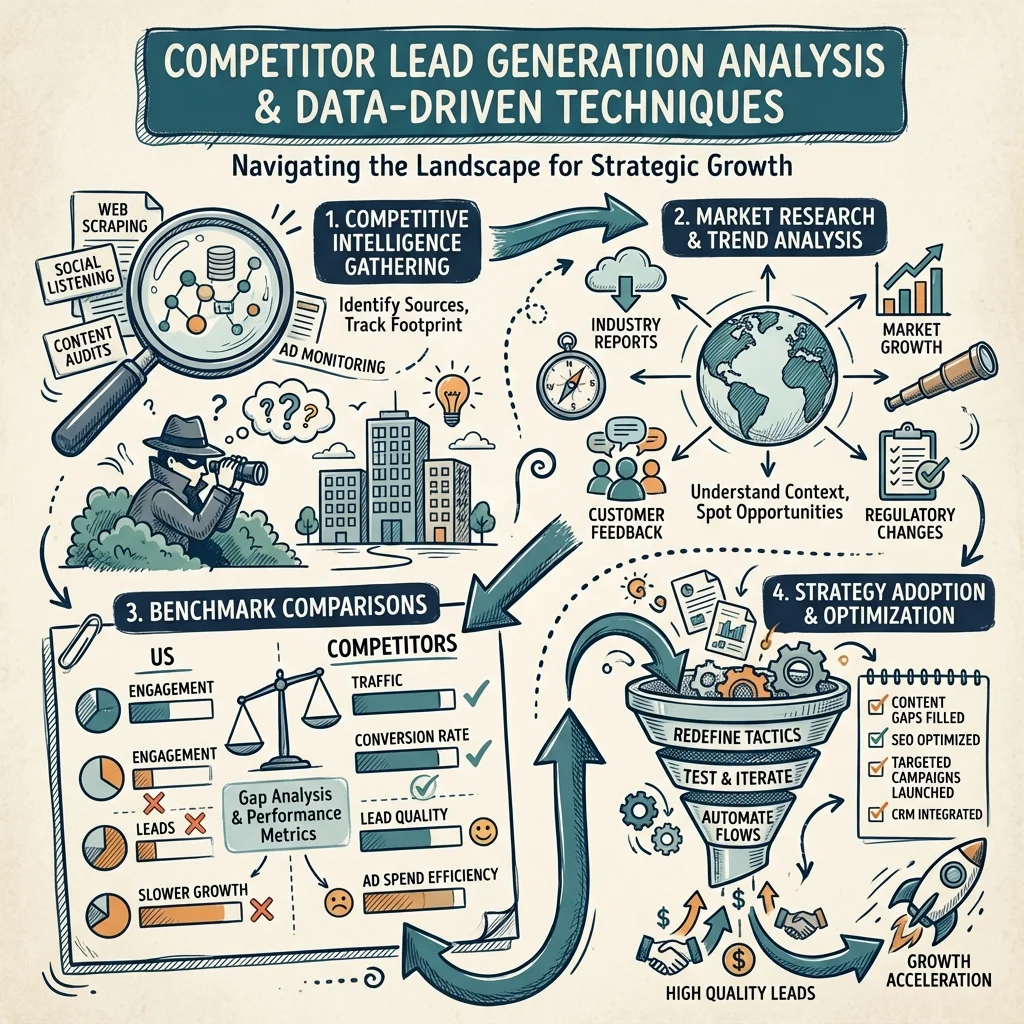
How to Use This Prompt (Step-by-Step Guide)
Customizing this prompt is where the magic happens. Here’s the exact process I use with my team to turn this template into a goldmine of competitive intelligence.
Step 1: Identify Your Target Competitor
Don’t just pick the biggest name in your space. Choose a competitor who:
- Has publicly shared results (case studies, earnings calls, blog posts)
- Matches your target audience profile
- Is aggressive with marketing (you see their ads, content, events)
Example: Instead of “HubSpot” (too broad), choose “Drift” for conversational marketing tactics or “ClickFunnels” for funnel-specific strategies.
Step 2: Define Your Industry Narrowly
Vague industries yield vague advice. “SaaS” is too broad; “B2B SaaS for financial services” is perfect. The more specific, the more relevant the tactics.
Good: “cybersecurity SaaS for mid-market enterprises” Bad: “tech”
Step 3: Insert Your Company Context
This is crucial. Include 1-2 sentences about your company size, current lead gen channels, and resources. This helps the AI tailor recommendations to your reality.
Real Example:
COMPANY NAME: "TechSecure (200 employees, currently using Google Analytics, HubSpot, and LinkedIn Ads; marketing team of 8; $50K monthly budget)"Step 4: Set an Ambitious but Realistic Time Frame
The time frame should create urgency but remain achievable. “30 days” forces quick wins; “6 months” allows for strategic overhauls.
Pro tip: Use “Q1 2025” or “next 90 days” instead of “3 months”—calendar context enhances relevance.
Full Customization Example
Original Template:
What are a few data-driven lead generation techniques that have shown success for {COMPETITOR NAME} in {INDUSTRY} that {COMPANY NAME} could possibly adopt within {TIME FRAME}?Version 1 (B2B SaaS):
What are a few data-driven lead generation techniques that have shown success for Gong in the B2B revenue intelligence SaaS space that RevenueVision (150 employees, using Salesforce, Google Analytics, and content marketing; 5-person sales dev team) could possibly adopt within the next 90 days?Version 2 (Ecommerce Agency):
What are a few data-driven lead generation techniques that have shown success for SmartBug Media in the ecommerce marketing agency sector that ConversionCraft (25 employees, specializing in Shopify, currently reliant on referrals and LinkedIn outreach) could possibly adopt within Q1 2025?Version 3 (Privacy-First Martech):
What are a few data-driven lead generation techniques that have shown success for Segment in the privacy-compliant customer data platform industry that DataTrust (startup, $2M ARR, focused on first-party data collection for healthcare) could possibly adopt within the next 6 months?Running these customized prompts through ChatGPT, Claude, or Gemini will produce dramatically different, hyper-relevant outputs compared to generic requests.
Pro Tips for 10x Better Results
Mastering the prompt is just the beginning. These advanced strategies will take your lead generation ROI to the next level:
1. Layer in Data Source Specifics
Enhance the prompt by specifying where the AI should “look” for success evidence:
...techniques that have shown success (based on their public case studies, LinkedIn engagement metrics, and reported conversion rates) for {COMPETITOR NAME}...This pushes the AI toward verifiable data rather than speculation.
2. Combine with Real-Time Research
Use tools like Browse.ai or PhantomBuster to scrape your competitor’s recent webinar registrations, paid ad library, or content performance. Then feed that data into your prompt:
“Based on this data showing Competitor X’s webinar registrations grew 300% after they started offering AI-generated content audits, what are a few data-driven techniques…“
3. Request Implementation Roadmaps
Append this to get action plans: “…include a week-by-week implementation plan with required lead generation tools and estimated budget.”
4. Focus on Machine Learning and AI Lead Generation
If you want cutting-edge tactics, specify: “…particularly those leveraging AI lead generation or machine learning lead generation for lead scoring and lead nurturing.”
5. Ask for Metrics and Benchmarks
Add: “For each technique, provide typical conversion rates and lead generation ROI benchmarks for {INDUSTRY}.“
6. Beware of the Privacy Compliance Trap
Always append: “…ensuring all tactics are privacy-compliant and support first-party data collection strategies.” This future-proofs your recommendations against cookie deprecation.
7. Create a “Prompt Chain”
Don’t stop at one answer. Use the output to ask follow-ups:
- “Which of these techniques requires the least technical lift?”
- “How would this change if our budget was cut in half?”
- “What are the risks of each technique?”
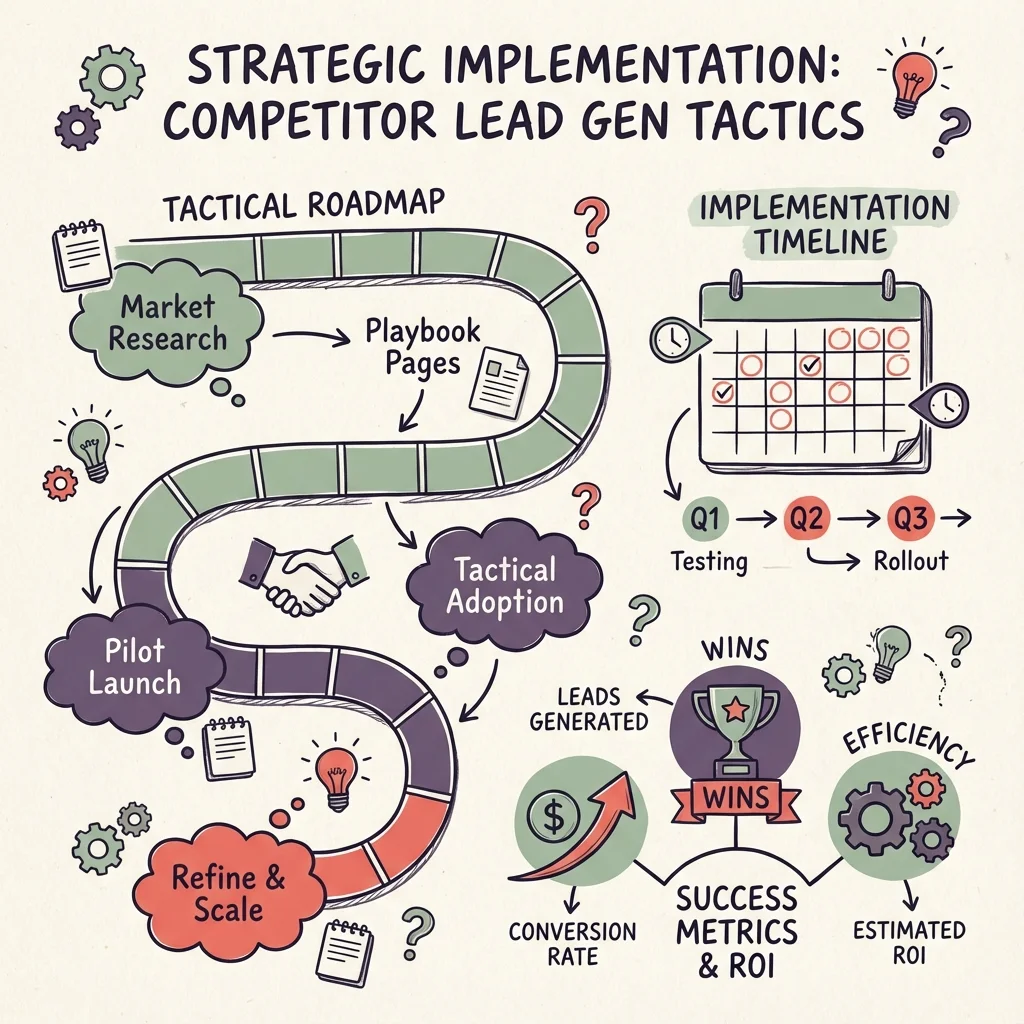
Common Mistakes That Sabotage Your Results (And How to Avoid Them)
Even a brilliant prompt fails if you make these errors:
Mistake #1: Being Vague About Your Competitor
Wrong: “Competitor: a big company in my space” Right: “Competitor: Lattice, the HR management platform”
Vague competitor names make the AI guess, delivering generic Fortune 500 tactics that won’t work for your scale.
Mistake #2: Ignoring Your Tech Stack
Failing to mention your current lead generation tools is like asking for directions without saying where you are. Always include your CRM, analytics, and automation platforms so the AI doesn’t suggest tools you’ve already invested in.
Mistake #3: Setting Unrealistic Time Frames
Asking for “groundbreaking techniques we can implement in 7 days” will yield either fantasy or band-aid solutions. Match your time frame to your team’s capacity. A 5-person team can’t execute what a 50-person team can in the same period.
Mistake #4: Forgetting to Specify “Data-Driven”
Remove that phrase and you’ll get opinion-based fluff. Always keep “data-driven” to ensure the AI looks for measurable outcomes, not gut-feel tactics.
Mistake #5: Not Verifying the AI’s Claims
The prompt gives you hypotheses, not facts. Always validate by:
- Checking the competitor’s actual website for evidence
- Using tools like SimilarWeb for traffic sources
- Reading their Glassdoor reviews for internal messaging clues
- Reviewing their investor reports for KPIs
Mistake #6: Ignoring Implementation Complexity
A technique might promise to improve conversion rates by 5x, but if it requires a year of custom development, it’s not a 90-day play. Always include your implementation constraint in the prompt.
Mistake #7: Overlooking Privacy and Compliance
In 2025, ignoring privacy-compliant strategies is business suicide. If you don’t explicitly ask for privacy-first tactics, you might get cookie-dependent strategies that will be DOA by mid-year.
Putting It All Together: Your Action Plan
Here’s how to implement this today:
- Spend 15 minutes identifying your #1 competitor and reviewing their public-facing marketing
- Draft 3 versions of the prompt with different time frames (30, 90, 180 days)
- Run each through at least two different AI models (ChatGPT + Claude) to compare outputs
- Score the recommendations based on: data evidence, alignment with your tech stack, and implementation speed
- Pick the top 2 techniques and create a 1-page implementation plan for each
- Present to leadership with projected lead generation ROI based on competitor benchmarks
- Execute for 30 days, measuring weekly, then iterate
This process has helped my team—and dozens of others I’ve advised—cut through the noise and focus on what actually moves the needle.
Conclusion
The difference between marketing teams that plateau and those that scale isn’t budget or headcount—it’s their ability to analyze lead generation data and rapidly implement what’s already working. This prompt is your shortcut to that capability.
Stop reinventing the wheel. Stop guessing. Start systematically deconstructing your competitors’ successes and rebuilding them for your context. The tactics are out there, hiding in plain sight within earnings calls, case studies, and LinkedIn posts. This prompt helps you connect those dots faster than any agency or consultant could.
Your next breakthrough lead generation strategy isn’t in a $5,000 course—it’s in your competitor’s public data, waiting for you to ask the right question. And now you have it.
Frequently Asked Questions
faq:
-
question: “How do I know which competitor to analyze?” answer: “Choose a competitor who shares similar ICP (Ideal Customer Profile) and business model. Avoid analyzing behemoths like HubSpot if you’re a 20-person startup. Look for direct competitors who publish results, case studies, or have active marketing you can observe. Their tactics will be more relevant and achievable.”
-
question: “What if my competitor is private and shares no data?” answer: “Even private companies leak valuable intelligence: LinkedIn ad libraries, webinar topics, content themes, job postings (which reveal their tech stack and priorities), and review site responses. The prompt works because ‘data-driven’ can include engagement metrics, ad spend patterns, and content performance—not just financials. Use tools like SpyFu, SEMrush, and BuiltWith to gather proxy data.”
-
question: “Can this prompt work for B2C lead generation too?” answer: “Absolutely. The framework is channel-agnostic. Replace {INDUSTRY} with specifics like ‘D2C subscription box for pet owners’ and the AI will surface relevant B2C tactics: referral program structures, SMS marketing, TikTok ad strategies, etc. The key is specificity in your industry and company description.”
-
question: “How often should I run this analysis?” answer: “Run it quarterly for strategic planning, and ad-hoc when you notice a competitor making bold moves (major product launch, new funding round, sudden media blitz). Markets shift fast; what worked last quarter might be saturated now. Use it as a pulse-check, not a one-time magic bullet.”
-
question: “What if the AI suggests illegal or unethical tactics?” answer: “This is rare when you include ‘privacy-compliant’ and ‘data-driven’ qualifiers, but always review suggestions critically. If an AI recommends dark patterns, deceptive ads, or non-compliant data scraping, discard it. The prompt is designed to surface legitimate strategies; unethical suggestions indicate you need to refine your company context to emphasize compliance.”
-
question: “How do I measure ROI from techniques discovered via this prompt?” answer: “Set baseline metrics before implementation (current cost per lead, conversion rate, MQL-to-SQL ratio). Run the new tactic for 30-60 days exclusively, then compare. Use Google Analytics for attribution, your CRM for lead scoring changes, and calculate ROI as: (Revenue from tactic - Cost of tactic) / Cost of tactic. The prompt’s strength is that it provides benchmark data to set realistic ROI targets.”
-
question: “Can I use this for account-based marketing (ABM) strategies?” answer: “Yes! Specify ABM in your industry description: ‘ABM-focused enterprise SaaS for supply chain.’ The AI will surface tactics like intent data platforms, one-to-one video personalization, and strategic webinar partnerships. For ABM, extend your time frame to 6-12 months since enterprise sales cycles are longer.”
-
question: “What’s the biggest limitation of this prompt?” answer: “It can’t access real-time internal data from your competitor. It synthesizes public information and patterns. You must validate its suggestions. Think of it as a supercharged research assistant, not an infallible oracle. The magic happens when you combine AI insights with your own customer data and market intuition.”